
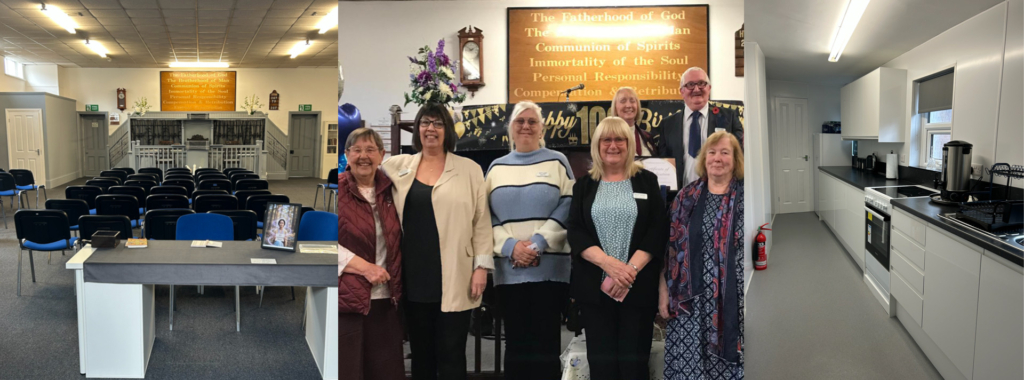
One conversation at a centenary celebration set in motion a six-month transformation at Newcastle Heaton and Byker Spiritualist Church. What began as a much-needed programme of repairs led to a complete transformation that has created a safer, brighter and more welcoming church, starting a positive ripple effect that is already reaching far beyond the building itself.
On the night Newcastle Heaton and Byker Spiritualist Church reopened following its recent extensive refurbishment, Secretary Amanda Carr stood before a full congregation to lead the service.
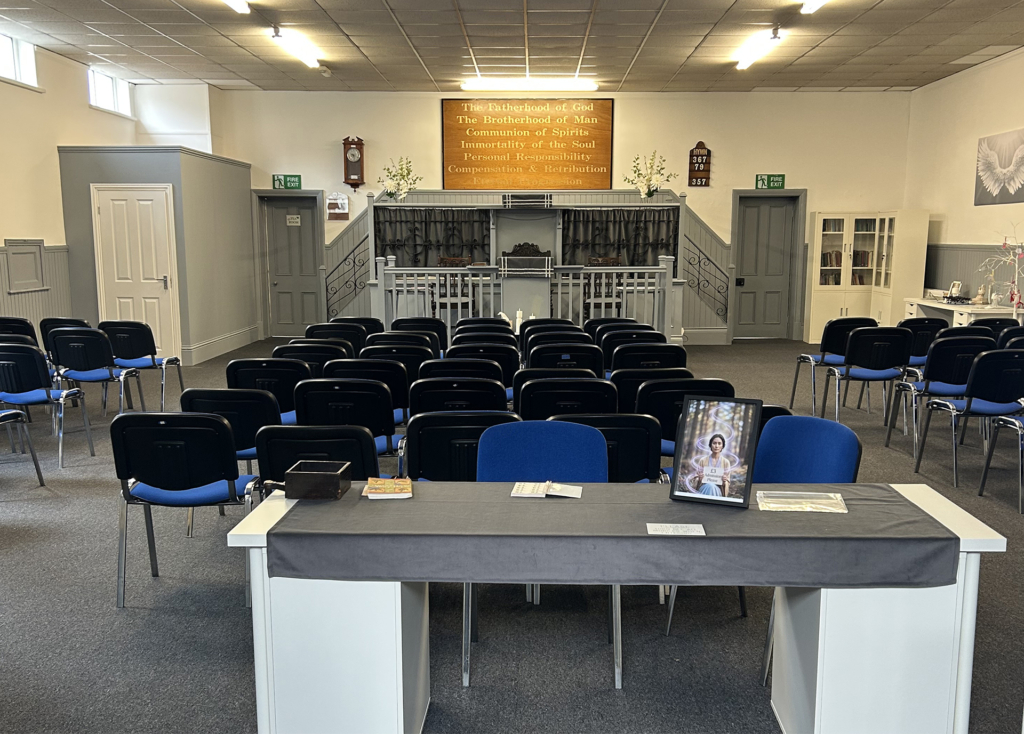
Around her was a building that those attending had known for years, yet one which now felt distinctly different. The dark mahogany features had given way to a softer grey palette. New carpeting stretched across the church, bringing together a floor that had previously been divided between different surfaces. The rostrum had been refreshed, new furniture introduced and formerly wasted corners put to practical use.
It was clean, coordinated and welcoming.
More importantly, it was safe.
Yet as people settled into their seats and looked around, it was not only the physical changes they remarked upon.
“The night we opened, I did the service and it was absolutely chock-full,” Amanda recalls.
“Everyone said how beautiful it was. Everyone mentioned the energy – it was lifted. All the old, stagnant energy was gone.”
That sense of renewal was fitting. A church that had scarcely received little more than occasional licks of paint in its century of existence had now been given so much more than just a facelift, but instead a whole new lease of life for its next chapter.
It was a transformation that would eventually come to encompass the main church, kitchen, tea room, toilet facilities, access routes, flooring, frontage, storage and decoration. It would involve contractors, committee members, volunteers, SNU support and a series of unforeseen complications that seemed to reveal themselves almost daily.
It began, however, with a single question.
In October 2025, Heaton and Byker celebrated its centenary, marking 100 years of Spiritualism, fellowship and service to its community.
The anniversary was rightly an opportunity to look back with pride, but it also encouraged the church to consider what would be needed to carry that work forward.
Like many much-loved buildings of its age, the church had been maintained through incremental improvements over the years. Those efforts had kept it functioning, but time had inevitably taken its toll. Parts of the building appeared dark and dated, while some practical limitations were making it increasingly difficult for the committee to develop activities or comfortably accommodate larger numbers of people.
Risky steps, awkwardly-positioned doors, warping woods, and even hazardous toilet cisterns were holding this church and its committee from their full potential.
There were also issues that could no longer be solved through decoration alone.
The centenary seemed the right time to ask questions, not least of all with the President of the Spiritualists’ National Union, Minister Jackie Wright, in attendance for the occasions:
“When we had our centenary, I asked Jackie, ‘Is there any way we could get some support to improve the church?’” Amanda says. “She said, ‘Yeah, yeah, I’ll get Andy to give you a ring.’”
It was an ordinary conversation, but one that would go on to have an extraordinary effect…
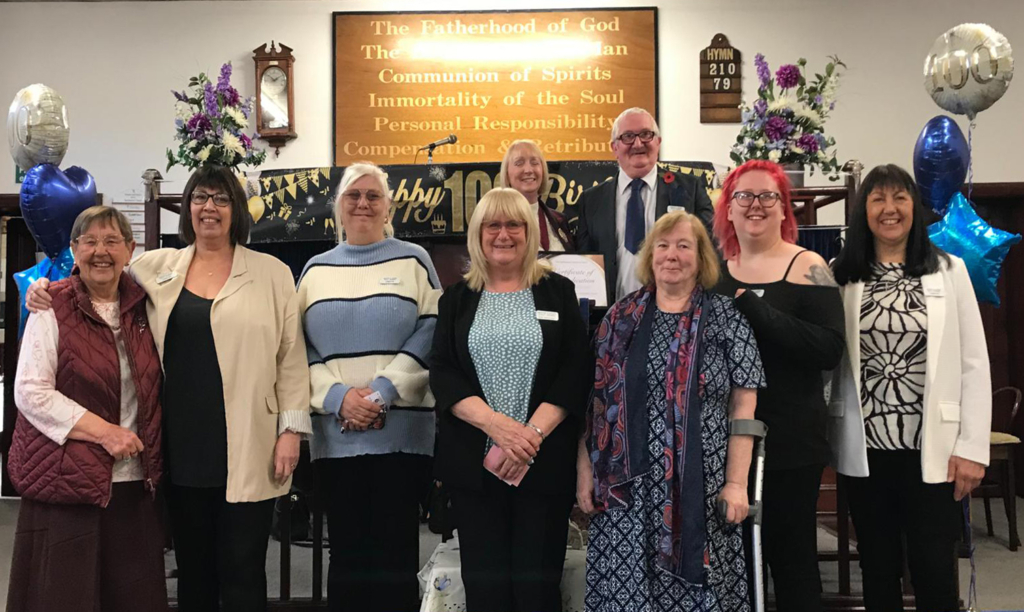
The night that started it all…: The committee of Heaton & Byker with Minister Jackie Wright on their centenary celebration in October 2025. From left to right: front row – Sheila Miller (Rostrum Chair), Amanda Carr (Sectretary), Lorraine Soul (Committee Member), Carole Anne Joel (Vice President), Anne Foster (Treasurer) Emma Soul (Committee Member), Alison Robson (Committee Member) back row – Minister Jackie Wright (SNU President), Kevan Embleton (Church President). Stephen Burton is also a committee member of the church, not present on the day above.
Andy Foley, the SNU’s National Property Manager, visited the church in January 2026, and Amanda took him through the building, explaining both the visible problems and the practical difficulties they were causing.
The church had only one usable toilet for those attending its services and events, which regularly resulted in people having to wait. Another older toilet contained a traditional high-level cistern that had become unsafe.
“The toilet was so old that when you pulled it, the cistern fell on your head!,” Amanda says. “We couldn’t allow people to use it.”
Bleakly comic, perhaps, but it was just one of a number of health and safety red flags that the committee wanted to address.
The steps leading to the kitchen and toilet areas did not meet modern safety expectations. Parts of the flooring needed attention, while the kitchen was no longer suitable for the kind of hospitality and community use the church hoped to offer.
Andy explained that support could be provided towards the extensive work, although the church would also need to contribute.
The committee agreed that the opportunity was too important to miss. It committed money from church funds towards elements including the new carpeting, balancing the need to protect its reserves with the long-term responsibility of caring for the building.
“It did mean dipping into our funds to get things done,” Amanda explains, “but we decided as a committee to get the money together for things like the carpet.”
The intention was clear, and the support from the SNU was in place. With the church also contributing towards the project (as they held the deeds to the church itself), the project to rejuvenate Heaton and Byker was well and truly underway.
The ball was rolling.
“The toilet was so old that when you pulled it, the cistern fell on your head!… we couldn’t allow people to use it.”
Before work commenced, the church invited a local council health and safety representative to inspect the building.
For some churches and voluntary organisations, the prospect of inviting an official inspection can be daunting. Amanda, however, believes it was one of the most valuable steps they took.
“People are a bit scared about getting health and safety in,” she says, “but it was definitely worth getting her in.”
The visit helped the committee understand that its plans needed to go beyond making the building look better.
In the kitchen, two windows were cracked and some chipboard surfaces could not be properly washed down. A separate handwashing sink was needed if the room was to operate as a working kitchen, whilst the existing gas cooker would also bring additional certification requirements, making a move to an electric appliance the more practical option.
“She gave us a lot of good pointers and was very helpful about what to do and what not to do,” Amanda says. “I wouldn’t even have thought about things like needing the second sink. Even when it is simple food and meals, you still have to have a separate handwashing sink in a working kitchen.”
The resulting transformation is striking. The old room has been replaced by a bright fitted kitchen with clean white units, dark worktops, an electric cooker, practical sinks and a washable safety floor. It is a modern working space that can support not only cups of tea after a service, but a broader programme of hospitality and community activity.
Elsewhere, improved flooring has reduced slipping risks and the unsafe steps have been addressed. Toilet provision has been reorganised to offer separate ladies’, gents’ and accessible facilities, including spacious new washroom areas, easing the pressure created when the church had only one usable toilet.
And, crucially, there’s no risk of having a cistern fall on your head!
A spare unit belonging to the builder was even installed in the accessible facility to provide baby-changing provision, at no extra charge to the church.
Naturally, such renovation work would make Newcastle Heaton and Byker more aesthetically attractive, but its real purpose was to remove the barriers that had been limiting what the church could safely do.
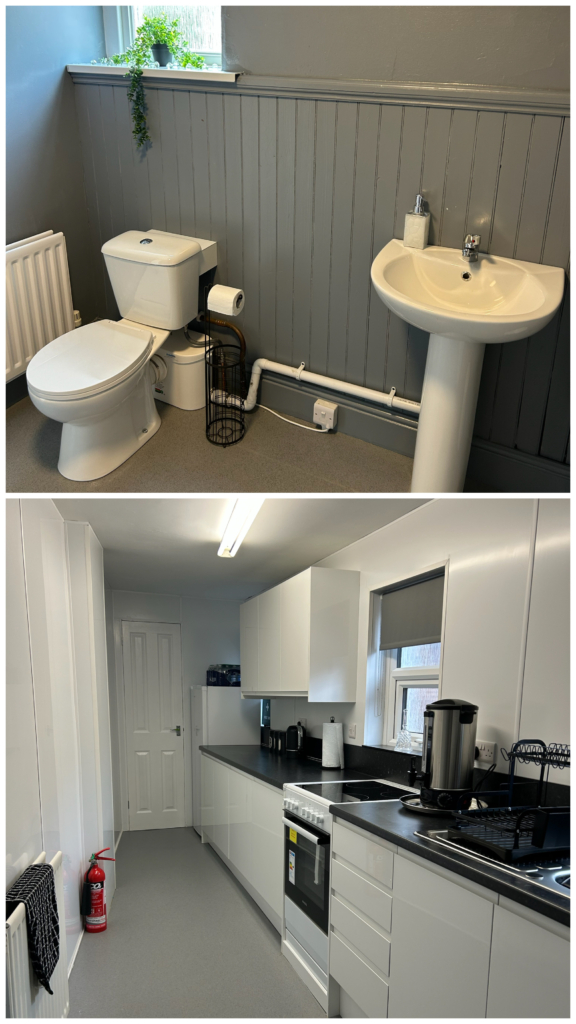
Stunning – and safe!: Some of the churches most essential facilities – including the toilets and kitchen areas – have been completely transformed into safe, clean, modern, hospitable spaces.
Work began in April and took approximately eight weeks.
Amanda became the principal link between the church committee and the contractors. Terry, the builder overseeing the project, kept in close contact, sometimes telephoning several times a day when decisions were required.
The committee helped select colours and materials, while Amanda kept everyone updated with photographs and progress reports through the church’s WhatsApp group.
She also became a familiar presence to the contractors.
“Every time I came in, they’d say, ‘Here’s the boss,’” she laughs.
Older buildings have a habit of keeping their most difficult problems hidden until work is already underway. At Newcastle Heaton and Byker, removing one ageing feature frequently exposed another issue behind it.
When the old toilet cistern was taken down, parts of the surrounding wall collapsed. Damp had penetrated the area, meaning that extra work would have to now be undertaken. Amanda and the builders knew that simply refitting the wall was not a viable long-term solution, so it was decided that permanent improvements and protective measures would be put in place.
Timed heaters have now been installed to reduce future damp, while the walls have been clad to provide a more durable finish.
This all involved extra costs, something Andy and the SNU were happy to support with.
Elsewhere, woodworm was discovered and affected timber had to be replaced. The old wooden boxing around pipes had warped and become unsafe. Some sections had simply been leaning in place, presenting another potential trip hazard.
When the team attempted to refit the old pieces, Amanda remembers that “it was like a jigsaw puzzle.”
Each discovery brought further conversations, revised costs and new requests for support.
“Every day when I went in, I’d joke, ‘What’s the drama today?’” she says.
Not every drama involved damp or structural work.
The church had selected grey to replace the heavy mahogany finish that once dominated the rostrum and other areas. The old wood proved difficult to cover and required specialist paint. Then, when one batch of the new colour arrived, with some coats already in place, it appeared to be something else entirely.
“At one point, when they got the paint, it was purple!” Amanda recalls. “I said, ‘We picked grey, not lilac.’”
The photographs of the finished church show the result of that persistence. The grey finish now runs through the main hall, entrance and facilities, creating a calm, coordinated appearance while retaining the church’s familiar character.
Amanda also intervened when plans for a new storage area began to become more elaborate than the church needed. A previously unused corner was initially going to become a walk-in cupboard with two sliding doors. Seeing the framework under construction, she proposed a simpler cupboard with a single door and internal shelving.
It is now a space for raffle tickets, hymn books and other church essentials, in a space that would previously have been wasted.
Terry eventually told her: “Just tell us what you want and we’ll do it.”
“Every day when I went in, I’d joke ‘What’s the drama today?’…”
Although Amanda coordinated much of the day-to-day work, the transformation was a collective undertaking.
Committee members contributed to the decisions, helped with additional painting and supported the many practical jobs that needed to be completed before the church could reopen. The church itself funded parts of the project, while as mentioned, additional SNU assistance helped address unforeseen problems as they emerged.
The contractors also went beyond simply completing a list of tasks. They provided extra paint for jobs the church team could carry out themselves, offered practical suggestions and worked with Amanda to find solutions as the project developed.
“Terry was really good,” she says. “He kept us in the loop the whole time, and he would always ring and check before he did anything.”
The scale of the effort became particularly apparent when it was time to clean approximately 100 chairs, and a ‘conveyer belt’ of volunteers and contractors was assembled!
Amanda took time away from her paid work and brought her cleaning machine into the church. Her daughter Abigail, who was home from university, joined her. The builders and their colleagues also became part of what developed into a highly organised production line.
One person vacuumed each chair. Abigail cleaned the upholstery with the machine. Amanda washed and polished the silver legs, while the builders carried and restacked the finished chairs at the other end.
After hours of lifting, cleaning and polishing, the builder’s son returned from the shop and called Amanda over.
“He said, ‘Here, I think you deserve it,’” she remembers. “And he handed me a can of lager!”
By the end of the day, Amanda could barely walk.
“My knees were killing me,” she says, “but we had such a laugh.”
“It was a lot of hard work, but there were lots of fun and games.”
Those moments of humour mattered. The project involved difficult decisions, physical work and the pressure of responding to costs nobody had anticipated. Yet it also brought committee members, family and contractors together around a shared purpose and a vision for what this new era for the church could become.
One of the most significant changes took place in the tea room.
An old stage at the rear had once served as the church’s platform, but it was no longer needed. Instead, it occupied valuable floor space and limited the number of people who could comfortably gather during events.
“We were struggling when we had events because we didn’t have enough room in the tea room,” Amanda explains.
It was another suggestion of Andy’s to have the stage removed and the flooring replaced, a decision that has opened the room up considerably. New tables have also replaced furniture that Amanda felt was no longer particularly inviting.
The result can be measured not simply in square footage, but in the way people now use the church.
“We are finding that a lot more people are staying afterwards for tea and coffee,” Amanda says.
It is a seemingly small change, but an important one.
A church’s work does not take place only during the formal parts of a service. It continues in the conversations afterwards: in the welcome offered to someone attending for the first time, in friendships strengthened over a cup of tea and in the moments when somebody feels able to stay rather than leave immediately.
By creating more space and a warmer environment, the refurbishment has made those connections easier.
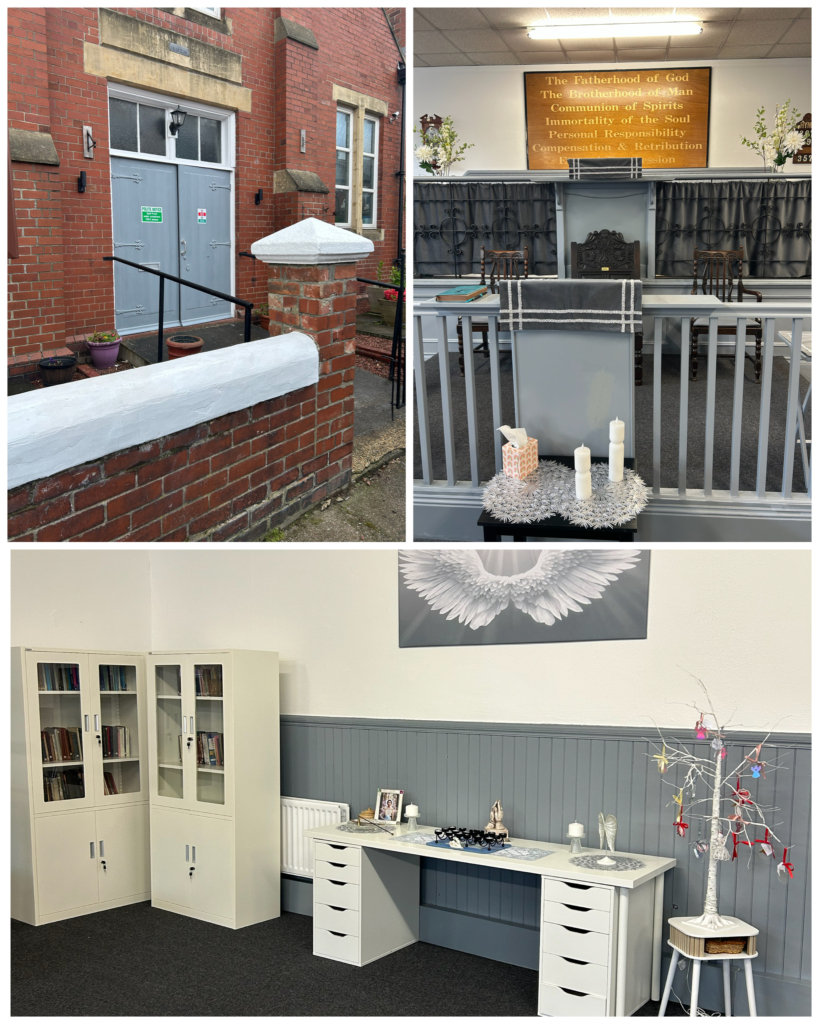
A front-to-back, top-to-bottom transformation…: From its repainted, redecorated door and frontage areas, right through to the very rear, every space and area in the church has been transformed and rejuvenated, from carpets to walls and all new purpose-built spaces.
Among the people Amanda most wanted to see the finished church was Jackie herself, who had known the building well before the works.
“I was dying for her to come and see it,” Amanda says.
When Jackie arrived, with a bouquet of flowers in hand, her reaction was immediate.
“She just said, ‘Wow – what a transformation,’” Amanda remembers.
Like the congregation on reopening night, Jackie noticed more than the new flooring, fresh paint and furniture.
“She commented on the energy straight away,” Amanda says. “She was totally flabbergasted, and it was lovely because she had seen the church before and after.”
Amanda is deeply grateful for the way Jackie combined practical support with a friendly and approachable manner throughout the process.
“I tell you what, Jackie has been absolutely amazing,” she says. “She is professional, but she is also the kind of person you can just ring up and have a chat with.”
Andy remained in contact, too, asking Amanda to keep him updated on the work and the money being paid out as the project progressed.
But perhaps the most important measure of the refurbishment’s success is not the paintwork, carpeting or new kitchen, impressive and striking though those things are. It is what those improvements are now allowing the church to do.
The considerable reworking of the church’s space, and making so many of its areas and facilities not only more appealing but actually safe and fit for purpose, means the church is able to put on a whole host of new events. Coffee mornings with bingo and prizes, sound meditation sessions and developing a programme of special events on different evenings.
Amanda is also preparing to lead a Tuesday meditation class.
More people are coming through the doors, and more are choosing to remain afterwards.
“We’re getting a lot more people into the church,” Amanda says. “We’re doing a lot more events and more for the community. There is a lot that we are trying to do to bring more of the community in.”
The transformation has therefore become part of a much bigger story.
One conversation at a centenary celebration led to a supportive telephone call. That call led to Andy’s visit. The visit led to funding, quotations and a builder. The building work created safer facilities and more usable space. Those improvements have allowed new events to take place, new people to attend and new connections to form.
“There’s just a lot more positivity now. There are new faces all the times, so it has definitely been the facelift we needed.”
What began within the church’s walls is now spreading beyond them.
“There’s just a lot more positivity now,” Amanda says. “There are new faces all the time, so it has definitely been the facelift we needed.”
There is still more that Amanda and the committee hope to achieve. A century-old church will always require care, ideas and investment, and the team is realistic about the work that lies ahead Yet the most pressing barriers have been removed, and in many cases the trifecta of the church committee, attentive builders and Andy’s expertise have carefully and consciously put into place preventative and protective steps to keep the church safer, cleaner and structurally sound for decades to come.
Behind the newly grey entrance doors is a church that feels brighter and more open. The hall is ready for worship. The tea room is ready for fellowship. The kitchen is ready to support hospitality. The facilities are safer and more practical. Most importantly, the committee can plan new activities around what its community needs, rather than around what the building will permit.
The church’s history remains present throughout. Its traditional rostrum and declaration of the Seven Principles still stand at the heart of the main hall. The refurbishment has not erased that heritage; it has created a renewed setting in which it can continue.
“There is a lot that we still want to do,” Amanda says, “but we wanted to get the refurbishment done to give the church a fresh look and make it safe – which it is now – for the community, so they can get involved.”
That is perhaps the real transformation, and the real takeaway from a 2026 that has been so forward-thinking and transformative at Newcastle Heaton and Byker.
A project that began with repairs has created opportunity. A building that had been unintentionally restricting activity is now encouraging it.
And church marking its first century is able to face its next with fresh energy, greater confidence and doors ready to open more widely to welcome in and serve its community.
Amanda and the committee are clear that none of it would have happened without the people who responded when they asked for help.
“Myself and the committee would like to give a big thank you to Jackie and Andy for all their help and support,” Amanda concludes, “because we couldn’t have done it without them.”
From “What’s the drama today?” to “what a transformation,” it has been an eventful journey.
Its positive effects, however, like any meaningful ripple of change, are only just beginning.
by Kyle Pedley, SNU Communications.
first published Friday 31st July 2026.
For more information on Newcastle Heaton and Byker Spiritualist Church, please consider following their Facebook Page!
If you would like your Church, Centre or District to be considered for an upcoming Spotlight visit and article, please drop us an email on communications.events@snu.org.uk, outlining your interest and reasons for a visit.
The Spotlight series is intended to showcase, highlight and champion good practice and notable achievements at church or district level.
Queries & Accessibility options – Paper copies of this page are available on request. To receive a paper copy, or if you have any questions, or would like to discuss accessibility needs or other requirements, please contact SNU Head Office via email at snu@snu.org.uk or telephone on 01279 816363.
If you have any questions or concerns regarding this post, please feel free to get in touch.